
Read Allianz Trade's credit expert on current trends of global trade rebounding, uneven pace around the world, and the biggest risk for importers & exporters.

Regional Head of Distribution, Allianz Trade Asia Pacific
Ben Handley
Ben is the Regional Distribution Director at Allianz Trade Asia Pacific, the leading global trade credit insurer and a core component of Allianz global lines business.
Ben has a demonstrated history of managing key insurance accounts and providing financial risk consultation to major clients. With his skills in account management and sales team supervision, Ben is committed to promoting the importance of trade credit insurance to businesses in the Asia-Pacific region.
Q: Global trade is rebounding, despite uneven pace around the world. What trends are you seeing so far, and what are the driving force behind it?
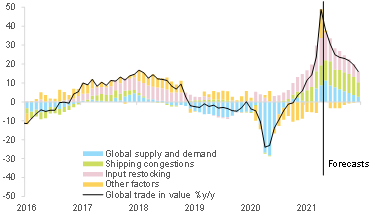
A: Global trade is certainly gathering speed and in the first half of this year the rebound was stronger than expected. In the first quarter, global trade has grown by 3.4% in volume terms, and outpaced by 8.6% of growth in value. The relative large gap in between the two numbers could be explained by global supply-demand imbalance.
While supply and demand was the key factor in global trade contraction throughout the Covid-19 crisis, it isn’t the biggest one in the rebounding stage. Our economists assessed the global rush for manufacturing inputs is the biggest contributor to recent trade flows. Especially for sectors such as transportation, textiles & apparel and computer & electronics, their stock level were not already high even before the crisis. Now they are shrinking even further.
Q: With the global race for inputs officially on, what is the biggest risk for importers and exporters?
A: With global trade we will also need to look at shipping arrangments. As demand from the US and Europe being exceptionally high, they are attracting a large share of shipping vessels and containers going their way. Not only the rest of importers and exporters will have to pay higher prices for shipments, it also put shipping delay at the worst spot in 10 years. As the world’s top credit insurer, our intellegence tracks global trade closely. Currently we assess 60-65% of shipping vessels are not arriving on time, up from 25% in Jul 2020 and 20% on average in 2019.
Q: How do you see this trend will go?
A: Unfortunatley, the shipping industry is not likely to normalize in the short-term as global recovery seems to remain uneven. Coupled with underinvestment by the maritime shipping industry over the past few years, new capacity only slowly coming online and lack of alternatives for ocean freight, we expect price and capacity pressures to stay on in 2022.
Q: What does the future hold for APAC businesses?
A: Thanks to new infrastrucuture cycle, fiscal stimuli, residual savings and further relaxation of trade tariffs, we expect global demand will continue to be sustained in 2022. Especially for trade tariffs, even after it has already declided by 0.6pp globally since 2019, we expect it will contiune to trend down in 2022 with the Regional Compreshensive Economic Partnership (RCEP) ratification.
The RCEP reduces non-tariff barriers by creating a common rule of origin, which reduces export costs. Our economists estimate that could boost goods exports among signatories by around USD90bn on average annually. Among which, China, Japan and South Korea would see the highest increase in annual goods trade.
Q: How should businesses seize such opportunities?
A: With the various state support schemes due to phase out, we expect global insolvency will be on the rise, hence payment risks. Businesses exposure to such should take action to review their credit management tools and seek ways to step up their accounts receivable protection against potential unpaid invoices and non-payments. As one of the top credit insurance companies in the world, Allianz Trade offers 100+ years of global trade intelligence which we can help our customers to pick the right buyers and avoid payment risks in the first place.
You might also be interested in...